ThreatLens transforms fragmented security signals into investigation-ready insights by correlating evidence, visualizing attack relationships, and providing AI-augmented investigation assistance across your security stack.
From fragmented signals to evidence-backed decisions.
ThreatLens connects signals from SIEM, EDR/XDR, cloud, identity, and threat intelligence sources, then correlates evidence, reasons over incidents, and produces investigation-ready outputs for human-led response.
No rip-and-replace. No black-box automation. Just investigation-ready intelligence across the tools your SOC already uses.
Not a single model guessing — a constrained team of specialists, each with defined responsibilities, tool permissions, and bounded autonomy.
Ingests SIEM/XDR alerts, extracts indicators, and normalizes events into structured incident context.
Enriches IPs, domains, and hashes with reputation, infrastructure, and historical intelligence.
Maps observed activity to tactics, techniques, and sub-techniques for structured attack context.
Finds shared infrastructure, reused hashes, and domain patterns to surface campaigns and clusters.
Produces structured, ready-to-run SOC response playbooks tailored to the incident.
Translates findings into containment, remediation, and severity-escalation recommendations.
Summarizes malware behavior, C2, persistence, and privilege escalation into a technical report.
Real-time detection of anomalous authentication, process, and network behavior in telemetry streams.
Decomposes tasks, selects agents, sequences execution, manages context, and enforces policy.
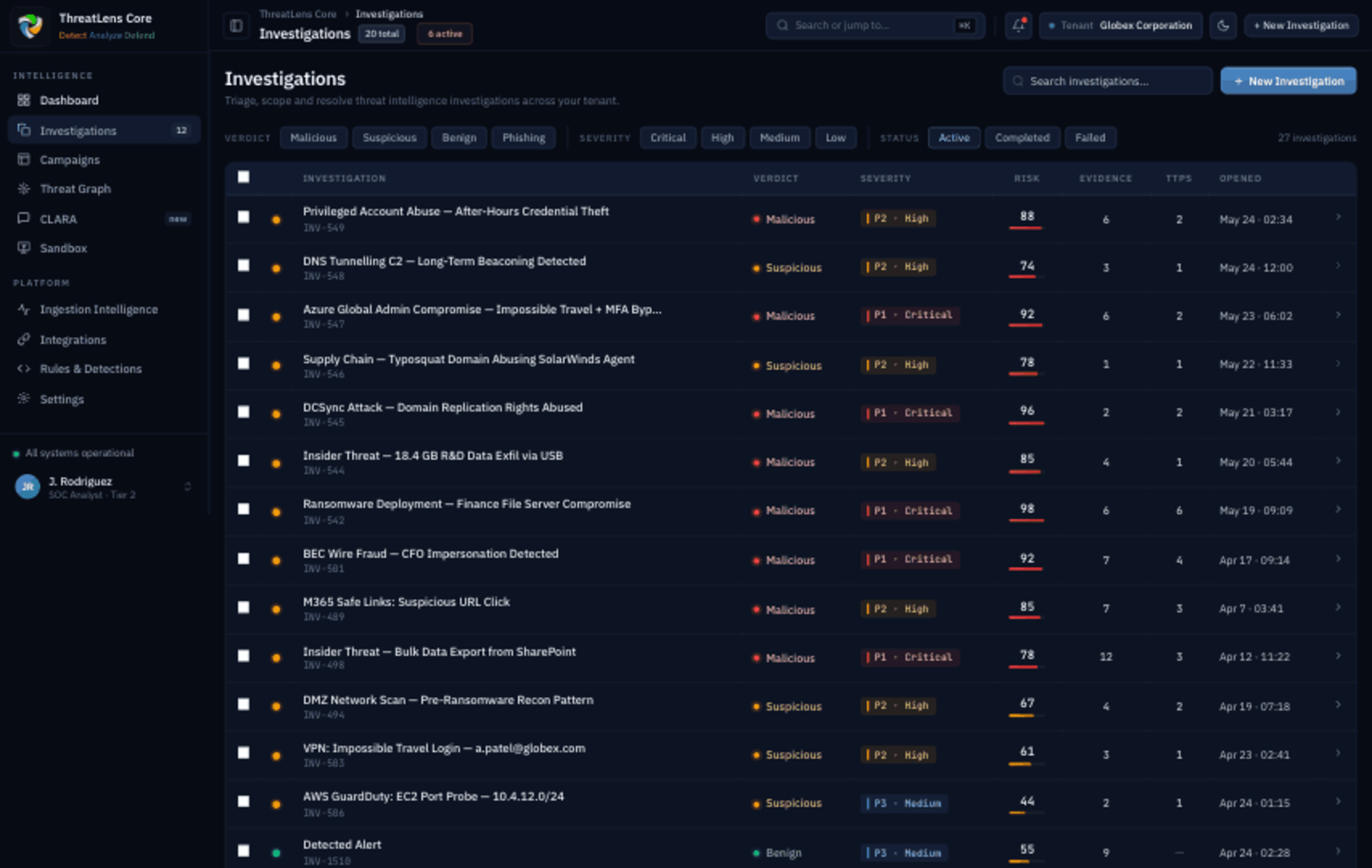
ThreatLens automatically correlates alerts, entities, telemetry, and threat intelligence into investigation-ready cases.
Analysts can quickly understand what happened, validate evidence, identify affected assets, and determine the next best action — without switching between multiple consoles.

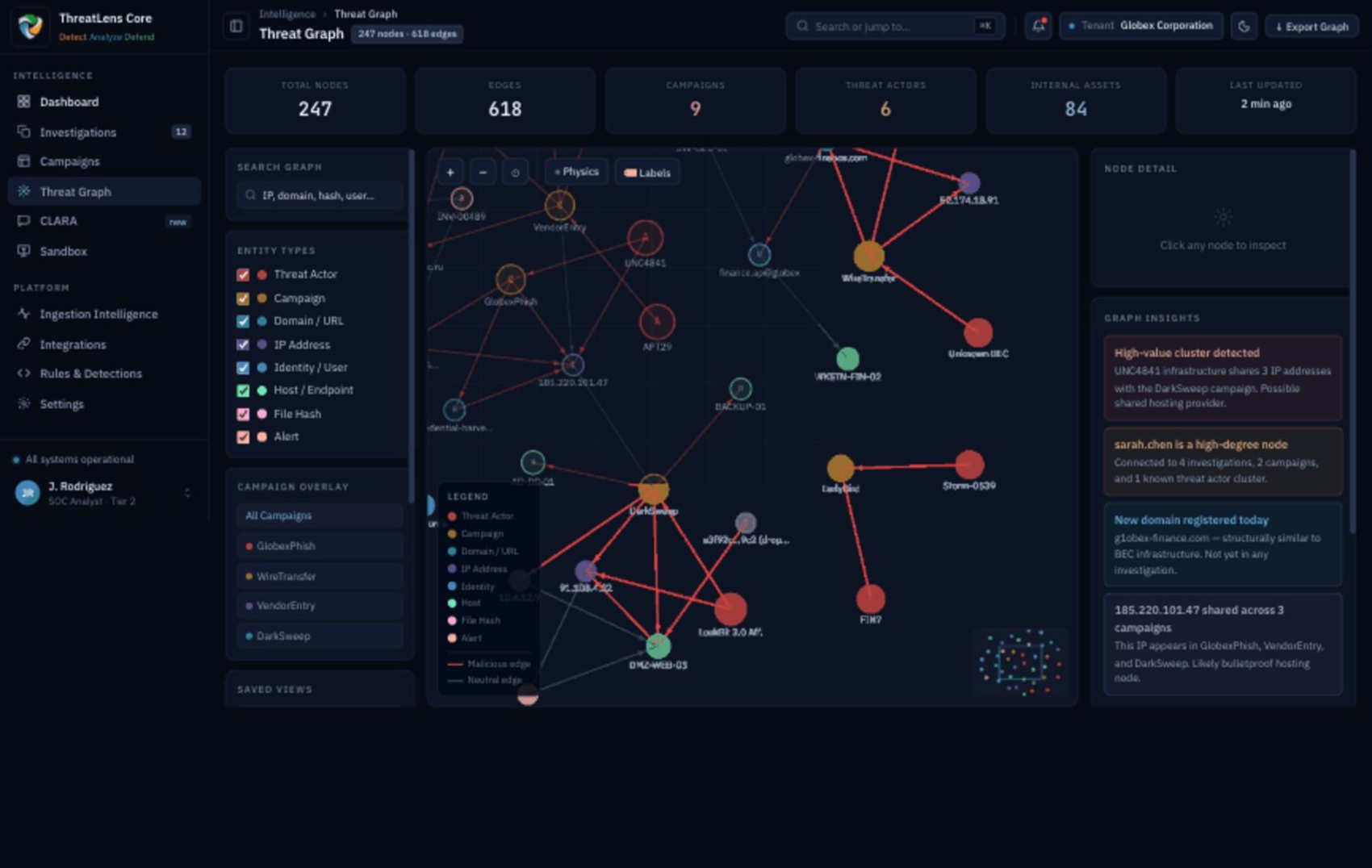
ThreatLens automatically connects users, hosts, domains, IPs, malware, campaigns, and incidents into an interactive evidence graph.
Analysts can uncover hidden relationships, trace attack progression, and understand the full scope of an incident.

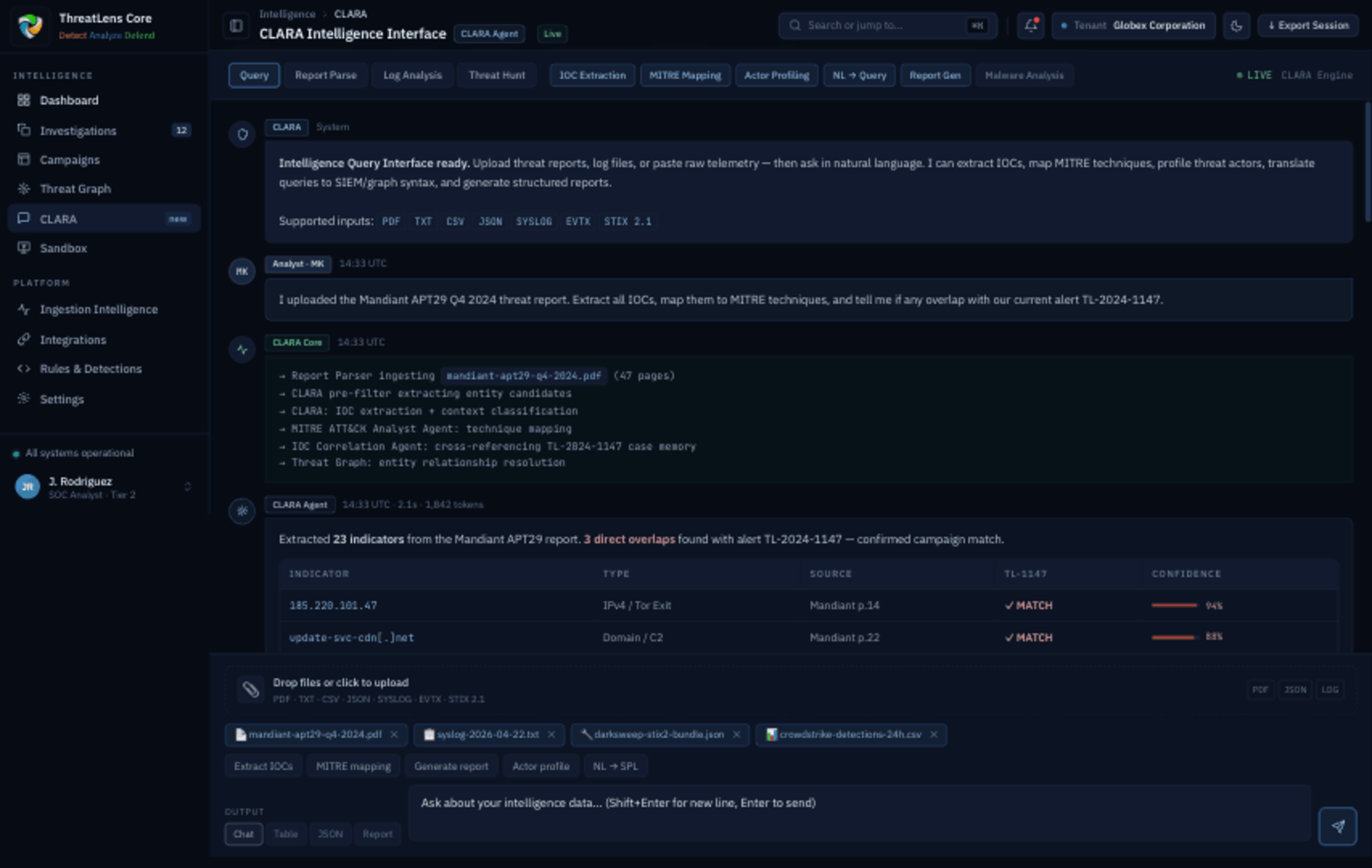
CLARA helps analysts accelerate investigations by providing contextual intelligence, evidence-backed summaries, threat analysis, and investigation guidance.
Designed specifically for cybersecurity operations, CLARA assists analysts throughout the investigation lifecycle while maintaining transparency and human oversight.

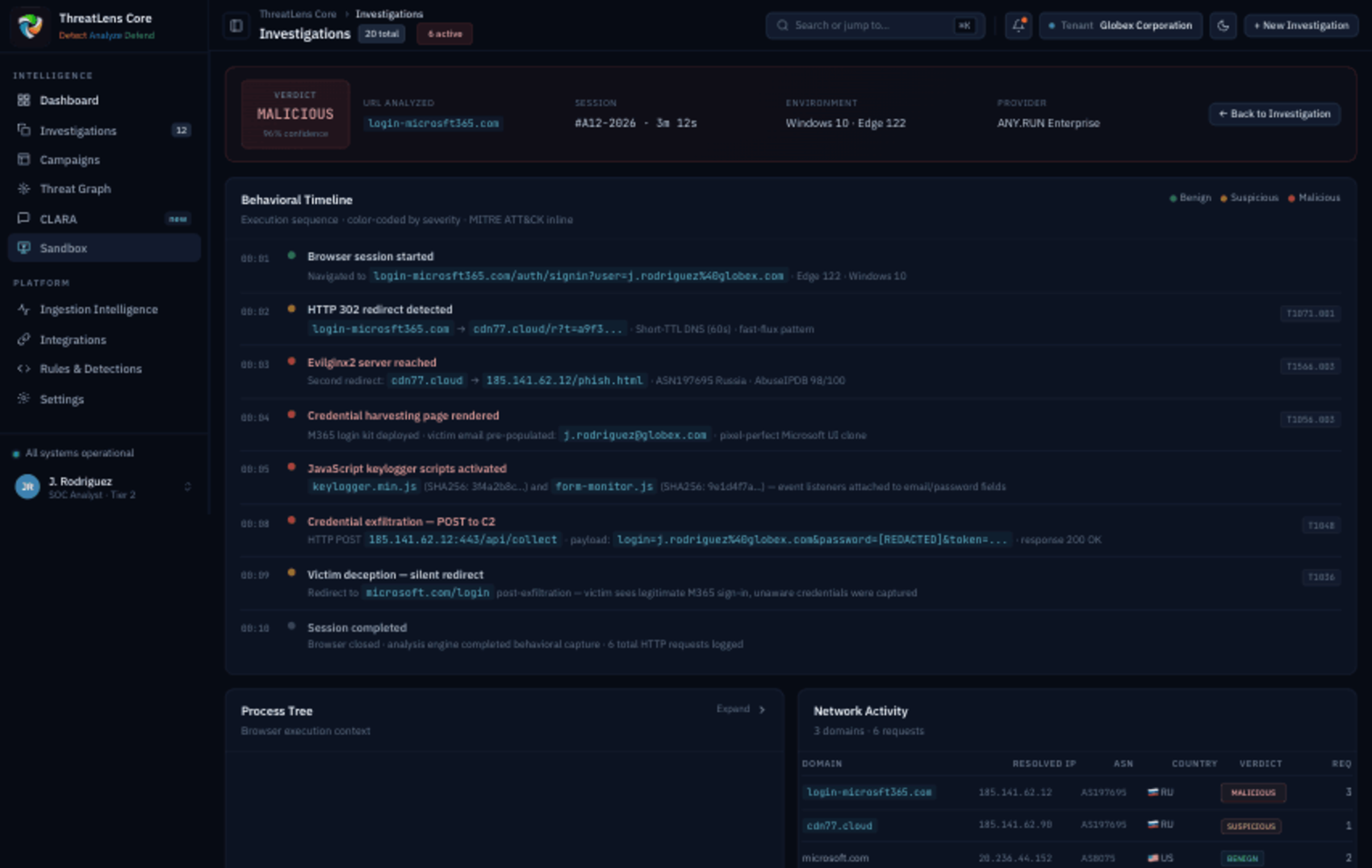
ThreatLens integrates malware and artifact analysis directly into investigations.
Analysts can examine suspicious files, identify malicious behaviors, extract indicators, and correlate findings with active incidents — without leaving the platform.

ThreatLens helps analysts investigate faster without sacrificing control. Every recommendation, conclusion, and response suggestion is tied to supporting evidence — ensuring analysts remain accountable for critical decisions.
Built for explainability, accountability, and operational trust.
Whether you operate an enterprise SOC, MSSP, or threat intelligence function, ThreatLens provides a unified investigation platform.
ThreatLens supports Public Cloud, Private Cloud, and On-Premises deployments with enterprise security controls and audit-ready workflows.
Explore our Trust Center →One company, one mission — investigation-grade truth and governed security across your stack and your AI.
The questions security teams ask most before bringing ThreatLens Core into their SOC.
ThreatLens Core is an AI-augmented threat investigation platform that helps security teams correlate evidence, investigate attacker activity, and generate response guidance across SIEM, EDR/XDR, cloud, identity, and threat intelligence systems.
No. ThreatLens Core works alongside your existing security stack. It enriches and correlates security signals to help analysts investigate incidents faster and make evidence-backed decisions.
ThreatLens Core integrates with SIEM, EDR/XDR, cloud, identity, and threat intelligence platforms, including Splunk, Microsoft Sentinel, QRadar, Elastic, CrowdStrike, SentinelOne, Microsoft Defender, AWS, Azure, Google Cloud, Entra ID, and Okta.
ThreatLens correlates related alerts, indicators, identities, and assets into investigation-ready cases. This helps analysts focus on high-confidence investigations instead of manually reviewing disconnected alerts.
CLARA is ThreatLens’ AI-augmented investigation assistant. It helps analysts analyze indicators, summarize investigations, map activity to MITRE ATT&CK, and generate evidence-backed investigation insights.
The Threat Graph visualizes relationships between users, hosts, indicators, malware, campaigns, incidents, and infrastructure, helping analysts identify attack paths and hidden connections.
ThreatLens can generate response recommendations and support automation workflows, but high-impact actions remain human-gated to ensure analyst oversight and control.
Yes. ThreatLens maintains complete audit trails, evidence sources, investigation history, MITRE ATT&CK mappings, and analyst actions to support transparency and compliance.
ThreatLens Core is available as Public Cloud, Private Cloud, and On-Premises deployments.
ThreatLens Core is designed for SOC teams, incident responders, threat hunters, threat intelligence teams, MSSPs, and enterprise security operations teams.
Discover how ThreatLens transforms fragmented security signals into investigation-ready insights and human-approved response guidance.